On 6 December 2025, a meaningful step was taken towards building safer and more inclusive systems for transgender and LGBTQIA+ persons in Golaghat, Assam.
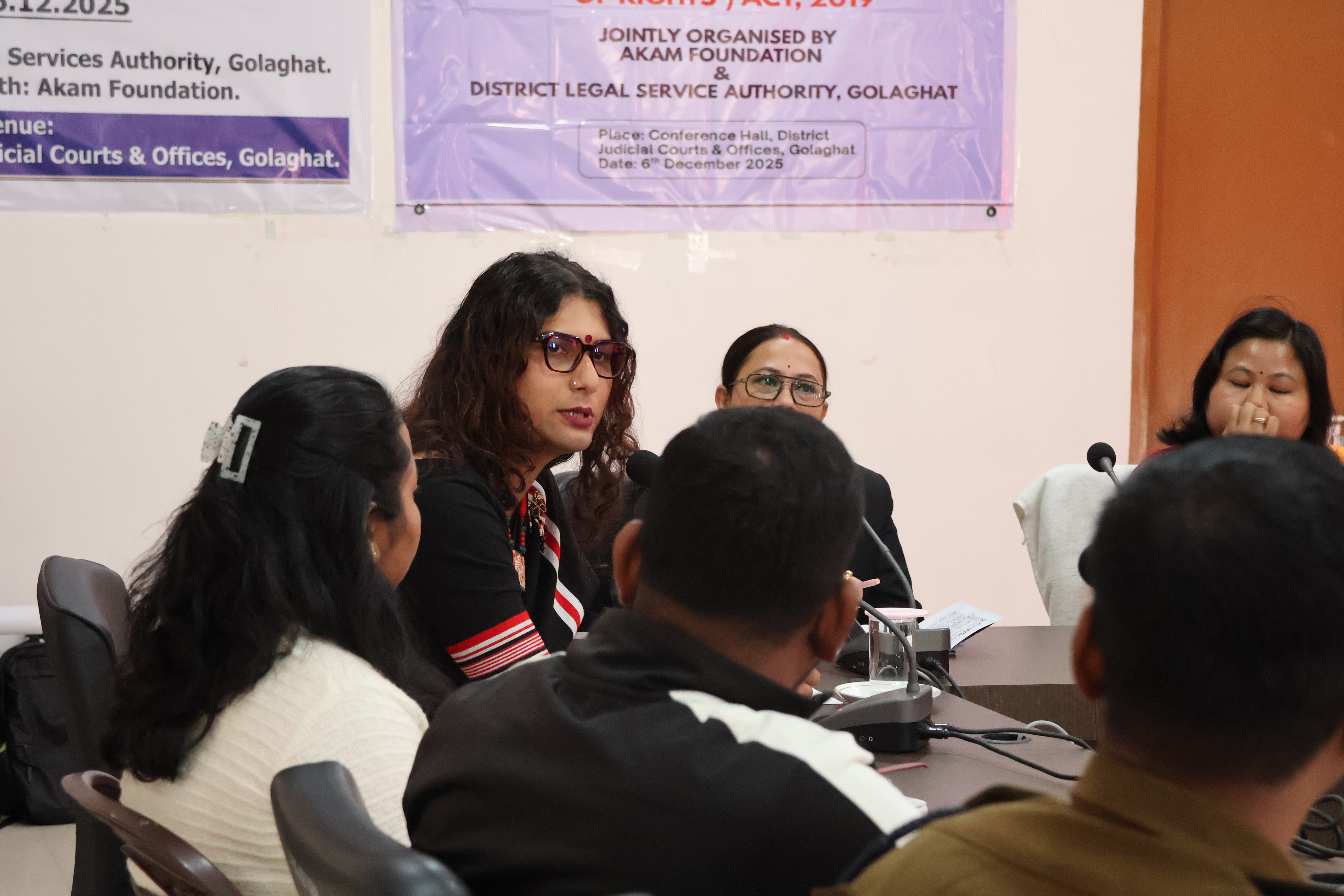
A Sensitization Programme on the Transgender Persons (Protection of Rights) Act, 2019, along with an Awareness Programme on Rights and Entitlements of LGBTQIA+ Persons, was jointly organised by the District Legal Services Authority, Golaghat and Akam Foundation at the Judicial Hall, District Judicial Court, Golaghat. Akam Foundation as a leading LGBTQIA+ organisation in north east India have been organising awareness program on rights of transgender individuals in different districts of Assam.
The programme brought together 48 participants, including law enforcement officers, representatives from the District Social Welfare Department, members of the District Legal Services Authority, North East Network representatives, youth leaders from Birangana Sati Sadhini University, and the Akam Foundation team.
The key objectives were:
-
To sensitise law enforcement and legal stakeholders on gender, sexuality, and transgender identities
-
To strengthen the understanding of the Transgender Persons (Protection of Rights) Act, 2019
-
To create a safe space for open dialogue between institutions and community organisations
-
To work towards access to justice, safety, and dignity for transgender persons
Opening the Space for Dialogue
The programme began with a warm welcome by Ms. Mridusmita Hazarika, Secretary, DLSA Golaghat. She thanked Akam Foundation for initiating the programme and appreciated the presence of police officers and stakeholders. She encouraged participants to engage openly, ask questions freely, and use the space to deepen understanding and institutional sensitivity.
Setting the Context: Understanding Lived Realities
Following this, Rituparna Neog, Director of Akam Foundation, introduced the organisation and its work across Assam. She spoke about the everyday realities faced by transgender persons, including exclusion from families, schools, workplaces, healthcare systems, and public spaces.
She highlighted how stigma, lack of awareness, and institutional gaps directly affect safety, livelihoods, and dignity. She also shared Akam Foundation’s ongoing work in:
-
Access to rights and entitlements
-
Livelihood support
-
Education and scholarships
-
Mental health and psychosocial support
-
Youth leadership development
-
Community and institutional sensitization
This grounding helped participants understand that the law does not exist in isolation it must respond to lived experiences.
Understanding Gender, Sex, and Sexuality
A session on the basics of gender, sex, and sexuality was jointly facilitated by Lipi Lahon and Rituparna Neog from Akam Foundation.
The facilitators explained:
-
The difference between sex and gender
-
What transgender and queer identities mean
-
Common myths and misunderstandings
This session helped build a shared vocabulary and reduced confusion around identity-related terms.
Deep Dive into the Transgender Persons (Protection of Rights) Act, 2019
The legal session began with an overview of the Act by Rituparna Neog, focusing on why it is especially important for police and legal institutions.
The detailed discussion was then led by Ms. Kakoli Baruah, Panel Lawyer, DLSA Golaghat. She explained key provisions of the Act and the Rules, 2020, including:
-
Legal recognition of transgender identity
-
Prohibition of discrimination in education, employment, healthcare, housing, and public services
-
Protection from abuse, violence, and harassment
-
Right to reside with family
-
Access to welfare measures
-
Grievance redressal mechanisms
-
Responsibilities of institutions and authorities
The session clarified legal duties while centring dignity and non-discrimination.
Open Discussion: Learning from Real Questions
One of the most valuable parts of the programme was the interactive discussion with police officers and participants. Some key themes emerged:
-
Handling cases involving transgender persons:
Officers discussed challenges during distress situations. The need for calm, lawful, trauma-informed, and dignified handling was emphasised. -
Legal consequences for harassment and discrimination:
Participants sought clarity on punishments under the Act. It was reiterated that harassment, bullying, and denial of services are punishable offences. -
Transgender certificate and identity card:
Many officers had limited exposure to these documents. Their differences, legal validity, and verification processes were explained. -
Judging “real” or “fake” identity:
Participants were advised not to judge identity and to rely strictly on legal procedures, ensuring dignity and equal treatment. -
Increase in begging among transgender persons:
Structural causes such as lack of education, employment, and skills were discussed, highlighting the need for inclusive livelihood opportunities. -
Same-sex relationships and cases involving minors:
A protection-oriented approach involving counselling and child protection mechanisms was stressed. -
Respectful language:
While hijra and kinnar are cultural identities, “transgender person” was clarified as the respectful and legally recognised term. -
Gender education:
The absence of gender education in schools and colleges was identified as a long-term concern requiring systemic attention. -
Inter-departmental collaboration:
Coordination between police, legal services, social welfare, health, education, and civil society was seen as essential.
Understanding Rights and Entitlements of LGBTQIA+ Persons
The final technical session was conducted by Mr. Sumant Singh, Chief Legal Aid Defence Counsel, DLSA Golaghat. He explained:
-
Rights and entitlements available to LGBTQIA+ persons
-
The role of legal aid institutions in ensuring access to justice and protection
This session helped participants understand how legal systems can actively support marginalised communities.
Reflections and Closing
During the feedback session, many participants shared that this was their first formal training on transgender rights. There was a strong consensus on the need for more such programmes.
The programme concluded with closing remarks and a vote of thanks by Rituparna Neog and the Secretary, DLSA Golaghat. Both institutions expressed interest in continued collaboration, and police officers showed willingness to engage in future sensitization initiatives.
Way Forward
The programme concluded with clear action points:
-
Regular sensitization and training for police, legal professionals, and frontline workers
-
Stronger institutional awareness of the Transgender Persons Act and grievance mechanisms
-
Gender sensitization in schools, colleges, and community spaces
-
Periodic community–institution interface meetings to build trust and improve services
Check Glimpses of the Program YouTube Video
Blog By: Communication Team, Akam Foundation
#AkamFoundation #LGBTQIA+ #RightsOfTransgender #TransgenderRights #TransgenderRightsInAssam